Perfume factory / buyer's field guide

Before you pay a perfume factory, know what you are buying.

Most costly quote problems start before the first email. Use this guide to define the product, market, quantity and packaging route, then compare every supplier reply on the same basis.

Build your brief

No paid supplier list. No generic factory ranking. Just the questions worth getting answered before a deposit.

Use it for
Your first factory quote
Format
9 buying decisions

A step-by-step buying guide

What should be clear before you ask for a perfume quote.

You do not need final artwork or a finished formula to begin. But a useful first enquiry needs enough detail for a factory to state what is included, what changes the price and what still needs a decision.

01 What are you selling?

Format, size, fragrance direction and packaging route.

02 Where and when?

Sales market, target launch and documents to confirm.

03 What can change the quote?

Quantity, custom work, components and sample approvals.

Phase 01 · Define the brief

01

What do you need to decide before you email a factory?

Put these in your first enquiry: product format, sales market, expected quantity, packaging route and target launch date.

A useful first sentence: “We are preparing a perfume for [market] and deciding between a stock bottle and a custom carton.” It tells a factory what is fixed and what still needs a discussion.

“I want to make a perfume” is not yet a brief. State what you want to sell, where it will be sold and which parts you want the supplier to handle.

  • 01 Product type, bottle size and preferred concentration.
  • 02 Sales market and planned launch date.
  • 03 First-order quantity and packaging route.

Read: How to choose a private label perfume factory

Phase 02 · Build the product

02

What does the supplier actually include?

Ask whether the quotation is based on an existing product, a specification you provide, or the supplier's development support. Do not assume private label, OEM and ODM include the same work.

Watch the scope, not the label: two offers may both say “OEM,” while one prices stock components and another includes development work. Read the product list and approval steps before comparing names.

ModelBest forTypical trade-off
Private labelFast launch with an existing baseLess formula uniqueness
OEMProducing an agreed specificationRequires a clear brief
ODMUsing the maker's development capabilityDevelopment takes longer

Read: Perfume OEM vs ODM vs private label

03

What is creating the MOQ — and the price?

Ask for the minimums separately: liquid, bottle and cap, decoration, carton and assembly may each affect the order quantity and timing.

When a supplier says “MOQ 3,000”: ask whether that figure covers finished goods, fragrance liquid, cartons or a single component. The answer tells you which choice is setting the minimum.

MOQ is not one universal number. It changes with the formula, components, decoration and packaging work in your project. A stock bottle and existing fragrance base may have a different minimum from a custom bottle or a new fragrance development project.

Read: What determines a perfume factory MOQ? What affects manufacturing cost?

04

Specify concentration, bottle size and intended climate.

Tell the supplier the format you want to sell, not only the scent direction. Concentration, base, bottle size and intended climate are part of the product brief and should be confirmed during sampling.

EDT

Eau de toiletteConfirm the concentration and wear target with the supplier.

EDP

Eau de parfumState the bottle size and target customer in the brief.

EXTRAIT

ExtraitCheck the formula, packaging and sampling route together.

05

Choose stock, semi-custom or custom packaging.

Decide which components must be unique: bottle, cap, pump, label or carton. Stock components reduce the number of approvals. Decoration and printed packaging add customisation without requiring every component to be developed from scratch.

A lower-complexity first order

Stock bottle + tailored fragrance direction + printed outer box = fewer component approvals while still allowing visible brand differentiation.

Read: Stock vs custom perfume packaging

Phase 03 · Validate before production

06

Approve samples against a written checklist.

Record fragrance direction, spray performance, bottle and carton fit, label placement and document needs in one feedback sheet. Send one consolidated response to the supplier so sample changes can be tracked.

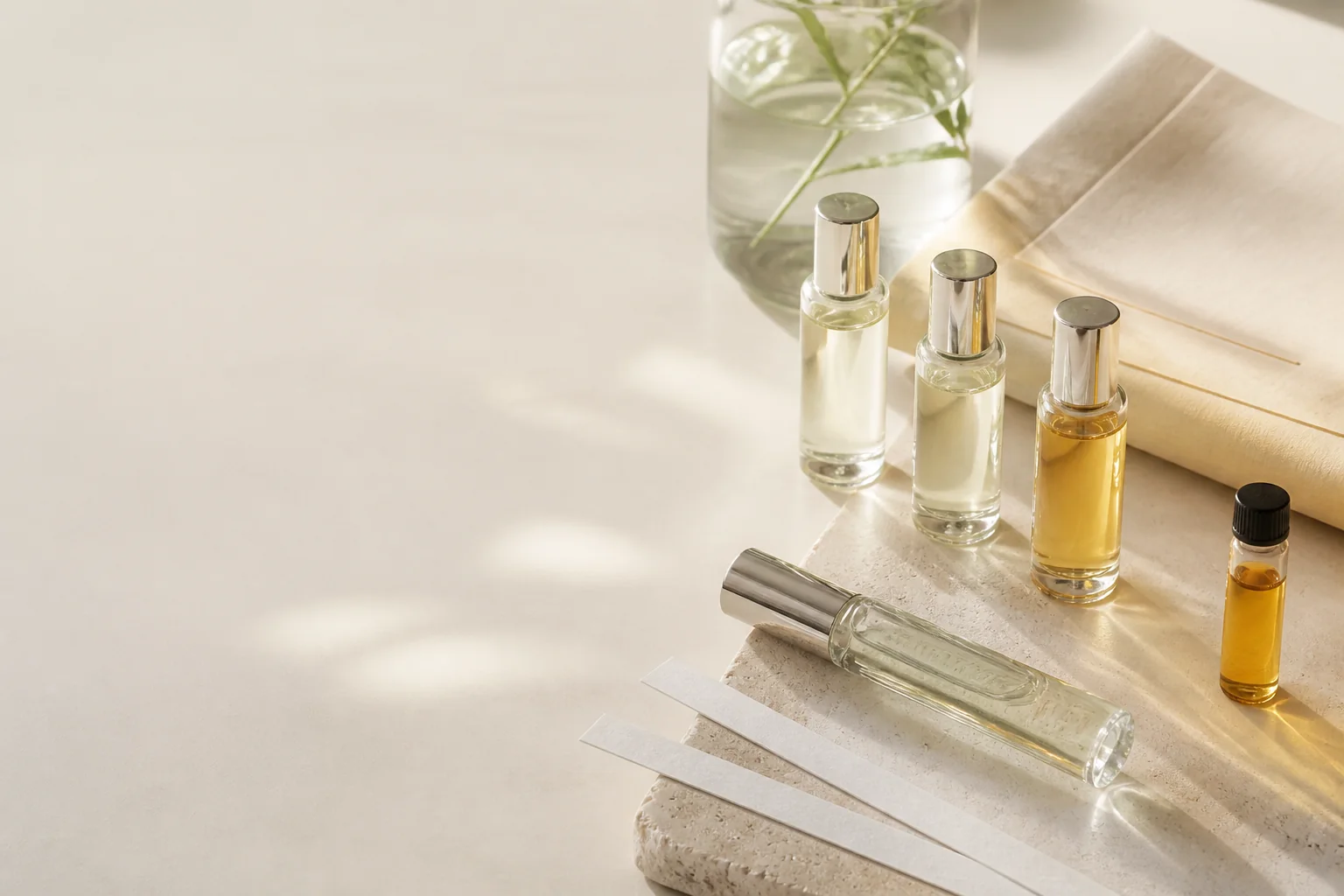
Unbranded perfume sample vials and blotter strips prepared for evaluation
Evaluate a sample against the full brief: fragrance direction, packaging fit, market needs and documentation.

Read: The perfume sampling process explained

07

List documents before you commit to the sales market.

Ask which documents the supplier can provide and which submissions, notifications or product claims remain the brand owner's responsibility. Generic documents are not the same as market approval for your final formula and packaging.

IFRA statementMSDS / SDSCOALabel review

Phase 04 · Select and act

08

Compare quotations line by line.

For each supplier, note the product specification, included components and decoration, sample process, documents, production lead-time factors and exclusions. This makes two quotations comparable even when the headline price is different.

Compare the two purchasing routes

Read: 20 questions to ask a perfume manufacturer

09

Send an RFQ with the details a factory needs.

Include the product format, sales market, expected quantity, packaging route, target launch date and document needs. Ask the supplier to state its assumptions and exclusions in the reply.

Read: How to write a perfume manufacturing RFQ

Straight answers

Five basic questions before you request a quote.

These definitions explain common purchasing terms. Confirm the actual formula, packaging, documents and sales market requirements with the supplier in writing.

What is a perfume factory?

A perfume factory may support fragrance development, filling, packaging and production coordination. Service scope varies, so ask which work is included in a quotation.

What is the difference between private label, OEM and ODM perfume?

Private label generally starts from an existing product base, OEM produces an agreed specification, and ODM uses a maker's development capability. The right route depends on speed, budget and how much customisation you need.

What determines perfume MOQ?

MOQ reflects the smallest efficient run for liquid, filling, components and packaging. Bespoke bottles, new fragrance development and specialist documentation usually require more commitment than stock components.

Which documents should a perfume buyer ask about?

Requirements depend on the product and intended market. Ask early which documents can be supplied, which claims need support and which responsibilities remain with the brand owner.

How should I compare perfume factories?

Compare project fit rather than a generic ranking: product format, expected quantity, packaging route, target market, included services and the points that must be confirmed before production.

Method and sources

What this guide can and cannot tell you.

This guide helps buyers prepare questions and compare quotations. It does not verify a factory's facilities, production capacity, certification, authorised distribution or product compliance.

The references below explain general industry and regulatory terminology. Compliance must be checked for the final formula, packaging and intended sales market.

Practical tools

Two simple tools for the first enquiry.

01 / PROJECT FIT

Project setup check

See which project decisions can change a production route. It is a planning prompt, not an MOQ or price calculator.

02 / PREPARE

RFQ draft

Fill in the core project details and create an English enquiry you can edit before sending.

A note before you choose

You can choose another supplier.
We still hope you do not get caught out.

You do not have to use our route. Before paying a deposit, ask for the product, components, price scope, sample approval steps and responsibilities to be named in writing.

We are not saying every other factory is a bad choice. We are saying unclear scope becomes expensive later. If something is not clear, pause and ask before you commit — whichever supplier you choose.

Two purchasing routes

Custom development
or ready stock?

Esan Perfume is for custom perfume development. Top Brand Perfume is for in-stock branded perfume products. Start with the purchase you are actually making; this is not a market ranking.

This guide is run by the team behind both featured routes.